Activating Alleys
Spatial Strategies of Abstract Painting
Thesis Study for M.Arch Degree
Boston, MA, USA
2020-2021
Providing identity and activation to alleys that lack color, light, and occupation by deploying interventions that focus on strategies of layering, entanglement, and movement.


There are few public recreational areas in the tight living spaces of a city. In the case of Boston, specifically Back Bay and the South End, alleys have been reduced to spaces for trash, parking, and back of house access. There is an oppertunity to redesign them to provide recreational space with a community aspect in mind.
 |  |
|---|---|
 |  |
 |  |
 |
Urban Analysis
The images on the left are a series of drawings used to conduct a study of Boston's context. The first image calls out Boston's neighborhoods, and how they overlap. The second and third images call out Boston's major roads and then its alleys (in red). The series continues on to call out a select few alleys, then starts to compare their different characteristics. The study is then summed up by comparing two different alleys and possible interventions for both.
Precedent Research
In looking to make a universal kit of parts, studying alley's and proposed interventions was a necessary exercise. The first row of images was focused on all types of interventions, and understanding their color choices, connections to the ground, and function. The rest of the images varry from studying two specific interventions and comparing them to the two chosen alleys in Boston.
 |  |
|---|---|
 |  |
 |  |
 |  |
 |  |
 |  |
 |  |
 |  |
 |  |
Design Process
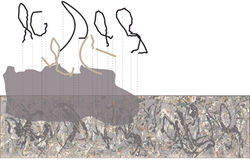
The design process started with exploring different art forms. Abstract Expressionism was chosen for its loose, bold, and expressive nature. Starting with created paintings to explore and understand the medium, there was then a shift to analyzing famous paintings.
 |  |  |
|---|---|---|
 |  |  |
 |  |  |
 |  |  |
 |  |  |
 |  |  |
 |  |  |
 |  |  |
 |  |  |
 |  |
Analysis of Abstract Expressionist painting as active compositions generates specific architectural language to activate and provide a common identity across the alleys. Spatial strategies of layering, entanglement, and movement are identified from abstract painting and translated into a kit of parts of architectural interventions that provide opportunities for different activities. The kit of parts is made up of elements that define threshold, provide partial enclosure, and evoke a multitude of community interactions.

To create an urban kit of parts that can be used universally, this thesis conducted case studies in two vastly different locations of the city. One resided in a residential area, while the other rested in a commercial zone. The demographics of the areas dictate the activity of the intervention. The residential zone specifically called for shared amenity space for residents in the area, while the commercial zone required a place of rest for those passing through.


Color Exploration & Case Study 1
The first few images focus on studying the context of Boston and how a color pallet can be developed for a particular city or context. Collages of either side of the alley are crucial to design decisions, and create sectional views. From there plan studies of demographics and building form were explored, along with a series of site sections. In this particularly narrow space, nested in the heart of the city, it was determined that an area of refuge was needed. Thus, an elevated pedestrian level was designed to cater to this, while ensuring the function of the alley remained uninterrupted. This upper level evoked a privatized and secure space. Providing opportunity to look at art, socialize, or eat, this space can be versatile in use, while focusing on the human within the city.
 |  |  |
|---|---|---|
 |  |  |
 |  |  |
 |  |  |
 |  |  |
 |  |  |
 |  |
Case Study 2
Collages of either side of the alley are crucial to design decisions and create sectional views. From there plan studies of demographics and building form were explored, along with a series of site sections. In this particularly residential zone, it was determined that a community learning and productive space is needed. Thus, stations of growing and trash collection are scattered throughout the alley. One end begins with panels educating residential families in the area about greenery and recycling. The panels then transition to aesthetically pleasing compositing and trash reception bins. From there, the other side of the alley finishes with community gardens. This space focuses on developing the area for the community, while allowing those passing through to observe the process.
 |  |  |
|---|---|---|
 |  |  |
 |  |  |
 |  |  |
 |  |  |
 |  |